
There are many well-known and popular caching plugins available, and their features and performance vary significantly. Most online tutorials focus only on the benefits of certain plugins, without discussing their pros, cons, or specific characteristics. As a result, many users are unsure which caching plugin is best suited for their website.
diiamo wrote this article, “Comparison and Recommendations for Popular WordPress Caching Plugins,” to help you understand the pros and cons of each caching plugin and find the one that best suits your website. If you have any questions, please leave a comment below, and we’ll respond promptly.
Why must I install a caching plugin on my WordPress site?
WordPress is a dynamic PHP website; every visit and every action involves querying the database and executing PHP code, which slows down the site and consumes a significant amount of server resources. If you’re building an e-commerce website for international trade, where your target customers are scattered and located far apart, page load times will be even slower.
Caching plugins can cache pages as HTML, or even as objects, transients, and more. Since they eliminate the need to execute PHP or query the database to dynamically generate pages, they significantly improve loading speed and greatly reduce the load on the server. They are among the must-have plugins for building a WordPress site.
Be wary of cheating cache plugins, cheating optimization
Some caching plugins are designed toGoogle Speed TestOnce they achieve better scores, they’ll optimize the website specifically to meet the scoring criteria, but in reality, there’s no substantial improvement in speed. Xiao D refers to this approach as “cheat-style optimization,” which serves no practical purpose. Moreover, it can easily cause the website to malfunction, thereby affecting Google rankings and ad performance.

NitroPack, Accelerator these 2 plugins have cheating optimization behavior, there are real cases, please carefully screening.
Share a case:
One of this site’s lifetime VIP members (who’s also in the same industry) asked me why our competitors’ websites load so quickly.

Xiaodi used the Google speed measurement tool to measure, the score is very good, and Xiaodi optimization is a level ↓.
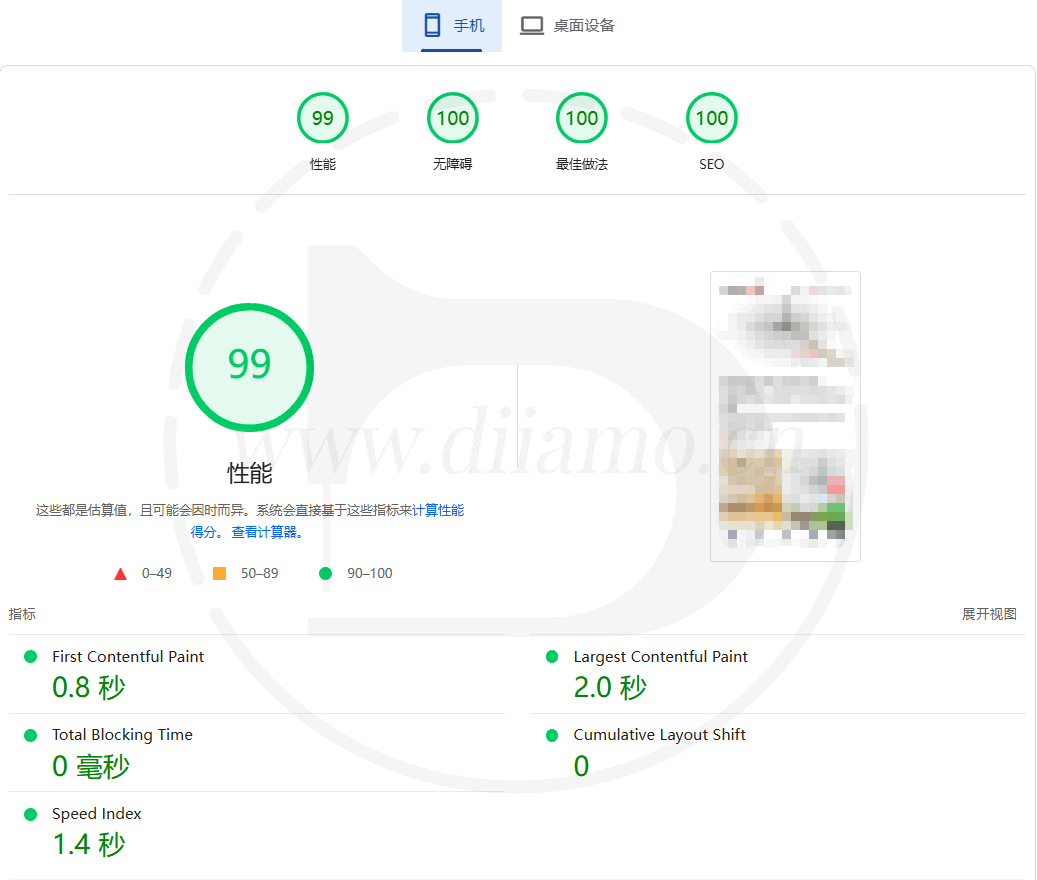
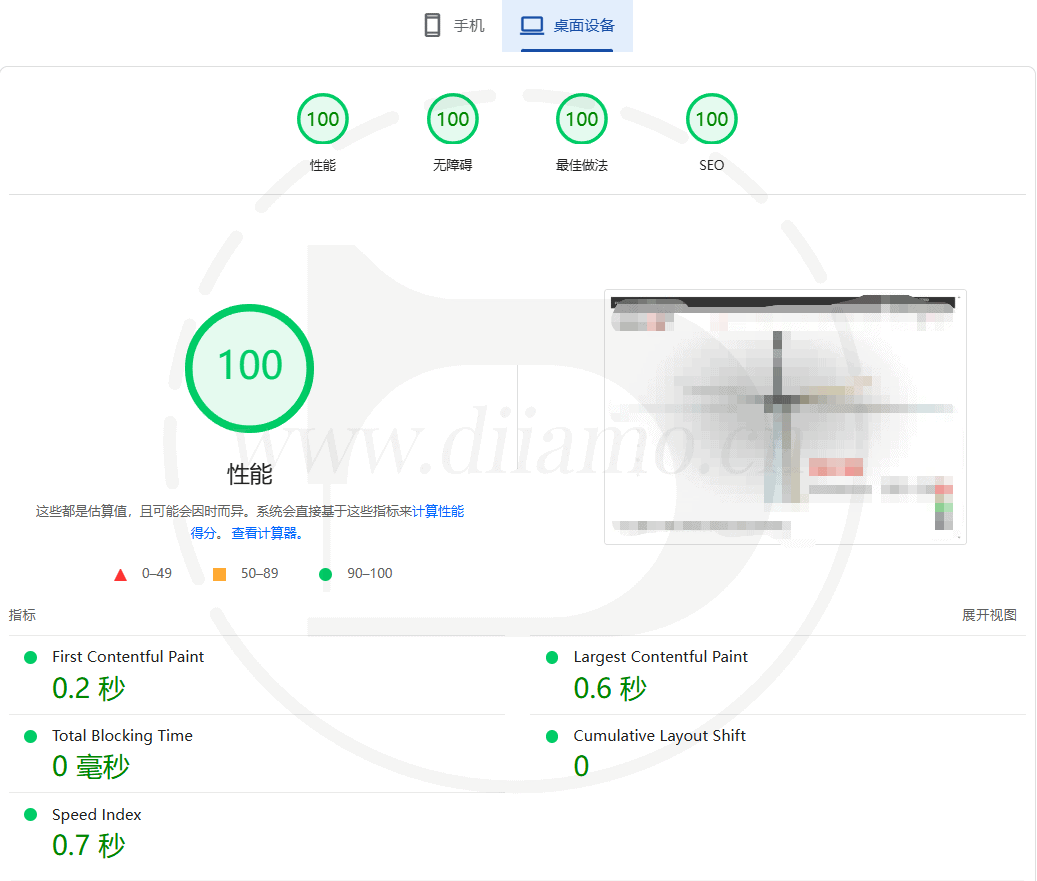
Xiao Di ran a test: the other site was also a WordPress site using a custom theme, without any major plugins like Elementor or WooCommerce. However, the actual loading speed wasn’t fast—the spinning circle in the navigation bar kept spinning for over 20 seconds before stopping, indicating that it took more than 20 seconds for all page resources to finish loading.
There is an online chat pop-up window in the lower right corner of the page, but the website image in the Google speed test result does not have this window; the board only starts to load when the page is pulled down, proving that it is delayed loading. From these points, we can see that the score of Google test is not the score of the website completely loaded, but the speed score of the website only loaded part of the speed score.
Take the marathon as an example, everyone's performance is calculated by the length of time it takes to reach the finish line, while Zhang San's performance is calculated by the length of time it takes to reach the halfway point of the race, so Zhang San's performance is very good, but his actual speed is not necessarily fast.
Xiao Di tested the product list page on that website. There were very few sections, and the content consisted of just a few images and headings, yet the loading speed was abysmal ↓. This shows that the website itself actually has poor performance; it’s just that the homepage has been specially “optimized” to make it look good on paper.
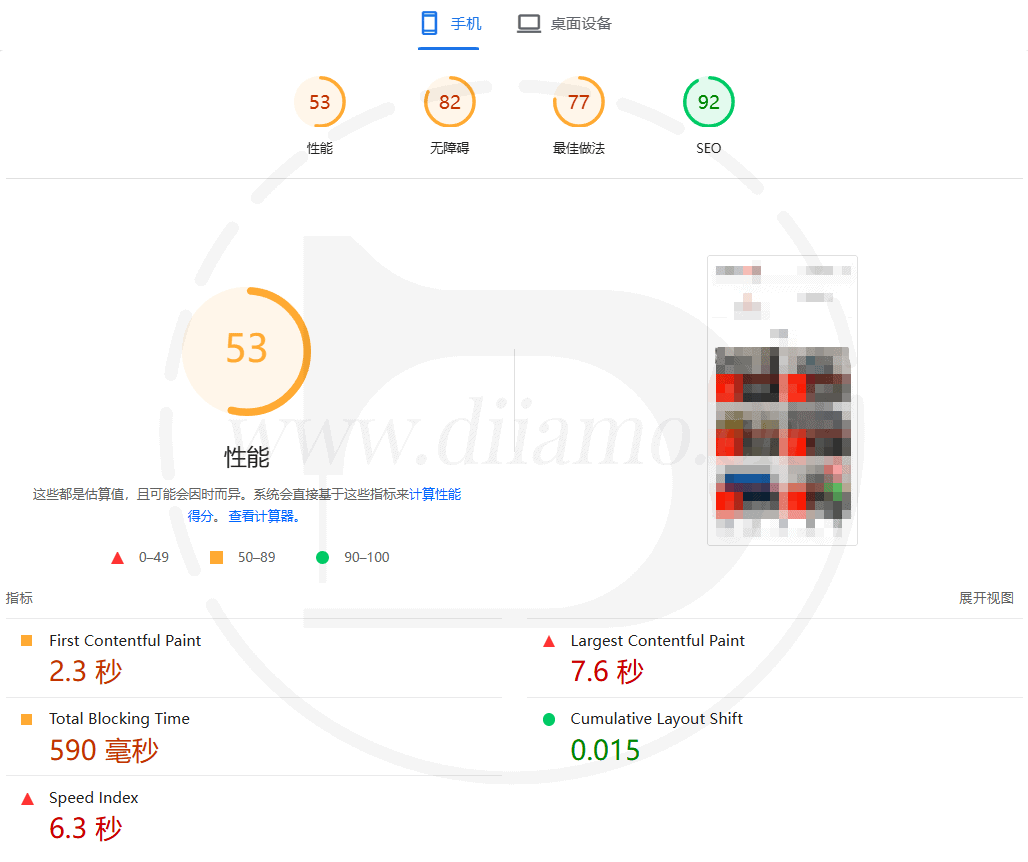
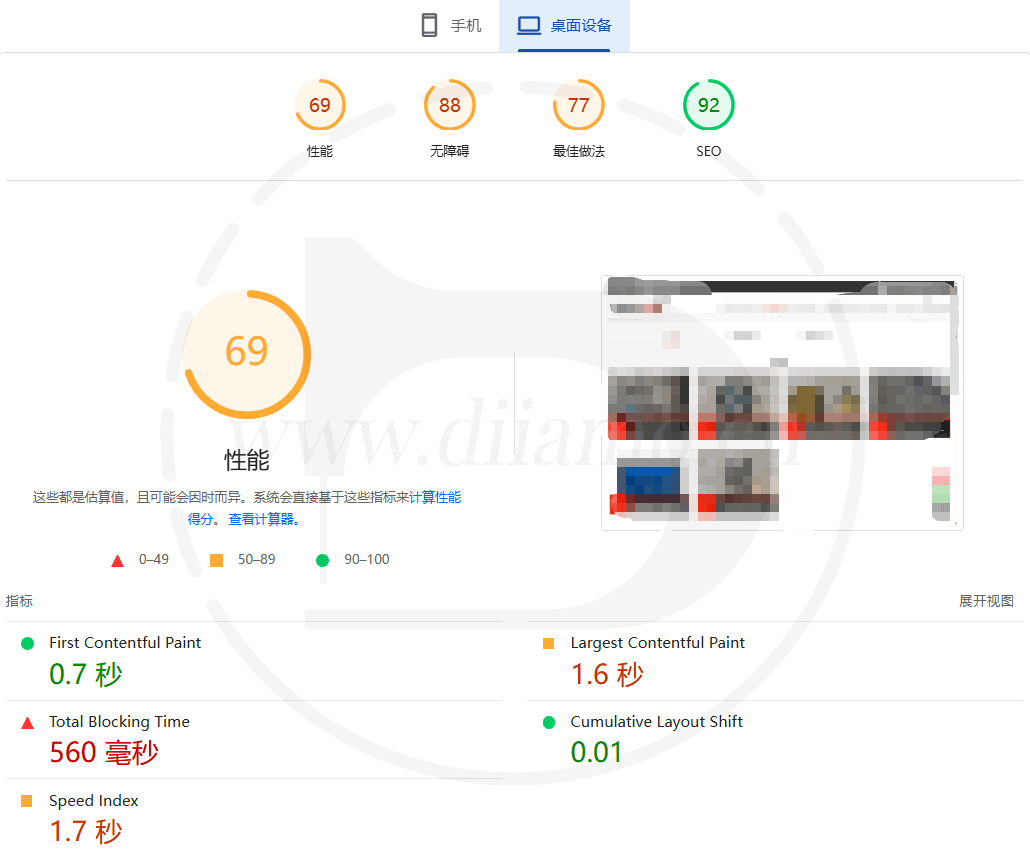
It's only really fast if it actually opens ↓!

After my analysis and enlightenment, this lifetime VIP member also understood what was going on, regained confidence, and knew how to explain to the boss as well as the customer 😎.

System-Level Caching vs. Software-Level Caching
There are three types of caching for WordPress sites: CDN caching, system-level caching, and software-level caching. CDN caching is essential and should be used in conjunction with system-level and software-level caching; I won’t go into detail about that here. Instead, I’ll discuss the differences between system-level and software-level caching, as well as their main advantages and disadvantages.
Nginx's `fastcgi_cache`, LiteSpeed's system cache, and Apache's `mod_cache` are system-level caches, while the caching implemented by caching plugins such as WP Rocket is software-level caching.
System-level caching is effective, but it’s difficult to configure, offers limited customization, has many restrictions, and is functionally limited, so few people use it. Software-level caching works well, is easy to configure, offers a high degree of customization, has good compatibility, and provides comprehensive functionality, which is why the vast majority of website builders (especially beginners) use it.
Workflow:
fastcgi_cache is enabled and a hit occurs:Visitor → Nginx checks the cache key → Hit → Directly returns the HTML from memory or disk → End.
Only enable WP Rocket, etc. (under the default Nginx configuration) and match:Visitor → Nginx → PHP-FPM starts → WordPress boots → advanced-cache.php (WP Rocket drop-in) → Hits static HTML → Outputs directly and exits.
Both cache levels are enabled and there was no hit:Visitor → Nginx → PHP-FPM → WordPress → Database → Render HTML → Write to Cache → Return
As you can see, when a cache hit occurs, `fastcgi_cache` bypasses the entire PHP + WordPress process, delivering the best performance and speed; WP Rocket, on the other hand, only bypasses the latter part of the WordPress process. This is the root cause of the difference in TTFB and concurrent processing capabilities.
Advantages and disadvantages of each:
Advantages of System Caching:
- Maximum performance ceiling: When a hit occurs, PHP isn't invoked, so in theory, you can squeeze tens of thousands of QPS out of a 2-core machine. For "read-heavy, write-light" scenarios like SEO sites and content sites, the performance gains are overwhelming;
- In-memory speed: Mounting the cache directory to /dev/shm results in read operations that are essentially performed entirely in memory, with TTFB as low as single-digit milliseconds;
- Comprehensive backend protection: PHP-FPM processes won't be overwhelmed by traffic, and the load on MySQL is virtually zero;
- Doesn't mess with WordPress: No drop-in plugins, no table modifications, and no additional scheduled tasks. If something goes wrong, just run `rm -rf` on the cache directory to restore it.
Disadvantages of system caching:
- If you only use page caching: CSS and JS in HTML will still be just as bloated as ever, so you’ll need to use a separate tool like Autoptimize to optimize resources;
- You'll need to set up the expiration mechanism yourself: The homepage not updating after publishing an article is the most common pitfall for beginners. You must use the Nginx Helper plugin or implement your own purge logic;
- Passive caching, no preheating: During the cold start phase, the first visit results in all MISSes, and sudden spikes in virus traffic may consist entirely of slow requests. To preheat the system, you’ll need to write your own crawler script;
- Limited customization: Logged-in users, shopping carts, multilingual support, and A/B testing all rely on `if` statements to check cookies and user agent (UA). If you miss even one check, User A’s backend cache might be displayed to User B—this is a security incident, not just a minor bug;
- Operations and Maintenance Dependencies: Switching servers, reinstalling the control panel, or upgrading Nginx can all cause the configuration to become invalid.
Software Caching (WP Rocket) Advantages:
- Ready to Use: Just install and activate it to see results—no server configuration required;
- Fully Automated Failure Logic: Hooks are attached to article publication, comments, and theme switching; edit any post and it’s cleared; automatically synchronized with the homepage, category pages, and feeds;
- Pre-caching Mechanism: The built-in crawler generates a cache based on the sitemap, so visitors will rarely encounter a "MISS";
- Customized security: logged-in users, WooCommerce cart, checkout page, automatic multilingual bypass—significantly lower risk of caching errors;
- More than just caching: We’ve also handled CSS/JS minification and concatenation, image lazy loading, font optimization, Google Fonts localization, and Heartbeat control—all in one go, covering most of the optimization items;
- Portable: No need to reconfigure when switching servers.
Software Caching (WP Rocket) Disadvantages:
- There is still a performance ceiling: PHP-FPM must still be launched on a hit, and TTFB increases significantly once the process pool is full;
- A Hidden Drawback in Nginx (Important): Under Apache, WP Rocket can automatically generate a .htaccess file to allow requests to read static files directly without going through PHP; however, under Nginx, it cannot modify the server configuration, so by default, it still relies on `advanced-cache.php` to serve the cache via PHP. To address this, you’ll need to manually implement the Rocket-Nginx configuration—this highlights the awkward reality that "for software caching to keep up with system caching, you ultimately have to tweak the server configuration." BaoTower users should pay special attention to this;
- Feature Overlap and Conflicts: Many of the optimizations it performs (compression, CDN) may conflict with CDNs or other plugins, requiring troubleshooting on a case-by-case basis.
Summary:To reach the absolute limits of speed and performance, you need to use system-level caching, but only those with extensive experience and technical expertise can make effective use of it. In most cases, using the software-level caching or caching plugins recommended below is the best solution.
Using two caching methods simultaneously can lead to problems: overlapping cache durations, out-of-sync clearing, and cross-contamination of response headers—resulting in situations where, after editing an article, the cached version remains outdated even after clearing the cache. Best practice: Maintain only one layer of full-page caching, while the other layer serves a supporting role (for example, use WP Rocket solely for file optimization, or use fastcgi_cache solely for page caching).
Top WordPress Caching Plugins Comparison Recommendations
Here are the pros and cons of a few popular caching plugins, along with which types of websites each one is best suited for. These are the ones that deliver great, stable performance—just stick with them; there’s no need to waste time comparing others. If you’d like to know the pros and cons of other caching plugins, feel free to leave a comment below.
First, the conclusion.LiteSpeed hosting requires the LiteSpeed Cache plugin. It can be used in conjunction with other caching plugins, but you’ll need to configure it properly—page caching can only be enabled in one plugin.
For non-LiteSpeed hosts, it is recommended to prioritize the use of FlyingPress plugin with FlyingCDN speed. Or use Wp Rocket is also good, see below for a comparison of the 2 plugins.
For more complex websites (such as e-commerce or membership sites), we recommend using LiteSpeed hosting, for exampleChemiCloud, there are features such as ESI to dynamically bypass the cache, perfect for Woocommerce e-commerce sites.
Nginx hosts can use W3 Total Cache with object caching and fragment caching, but the configuration threshold is high. White users use Wp Rocket is more appropriate.
 | Wp Rocket | W3 Total Cache | LiteSpeed Cache | FlyingPress |
| Acceleration effect (self-assessment) | ⭐⭐⭐⭐ | ⭐⭐⭐⭐⭐ | ⭐⭐⭐⭐⭐ | ⭐⭐⭐⭐⭐ |
| user friendliness | ⭐⭐⭐⭐⭐ | ⭐⭐⭐⭐⭐⭐⭐⭐⭐ | ⭐⭐⭐⭐⭐⭐⭐⭐⭐ | ⭐⭐⭐⭐⭐ |
| vantage | Easy to use, good compatibility | Powerful, complete, bypasses dynamic caching, fine-grained control available | Powerful, full-featured, bypasses dynamic caching, stress-resistant | Powerful, complete and easy to use |
| Disadvantages | Insufficient functionality and speed bottlenecks | Complex setup, high threshold of use, slightly poor JS/CSS optimization features | Complex setup and high threshold for use | No documentation, slightly less compatible |
| Object Caching Functionality | ✕ | ✓ | ✓ | ✓ |
| Link to Cloudflare | ✓ | ✓ | ✓ | ✓ |
| Fits the crowd | novice user | expert | expert | The beginner, the experienced person who is willing to make a difference. |
| What's the best site for | Simple website: blog, foreign trade independent website / official website | Complex sites: especially suitable for shopping and membership sites | Can only be used with LiteSpeed hosting, especially for shopping and membership sites. | all suitable |
The performance ratings are based primarily on the plugin's features and corresponding effects and are provided for reference only. Whether the results are good or not depends largely on how you use the plugin and how it works in combination with other plugins.
Wp Rocket
Wp Rocket(Also known as "Little Rocket") claims on its official website homepage that it is the number one WordPress caching plugin, and its sales figures and reputation certainly back up that claim. Click to view "Wp Rocket setup tutorialThe.
The best thing about small rockets is thateasy use, point and click the mouse 2 minutes to set up, accurately cut the vast majority of user needs. Good compatibility, its CSS, JS optimization has a quick exclusion option, the official website also has detailed explanations and solutions to the various problems often encountered.
In contrast, W3 Total Cache and Swift Performance plug-ins are very complex to set up, set up a bad site is prone to problems, a large number of white users to stop, so the popularity of some small. The things made by technical men are "paranoid" a bit.
Another reason for the popularity of small rockets isThe effect is obviousIt has a very noticeable increase in website speed, giving it a steady seat at the top of the caching ladder. However, it is mainly used by white users or some of the veterans who want to save time.
Compatibility is also good: WP Rocket, as a conservative caching plugin, has a policy of generating a local static cache “after the page has been processed”, which prevents visitors from triggering the back-end PHP to draw the page repeatedly on each visit, significantly reducing the load on the server.
It doesn't change the core process of WordPress “data checking + processing”, but adopts an intelligent cache splitting strategy: static content (such as page structure, CSS/JS, images, video player, etc.) is cached locally, while dynamic content (such as real-time comments, inventory counts, user login status, etc.) is processed directly by WordPress in real time. are directly handled by WordPress in real time.
At the same time, when the website content is updated, WP-Rocket will asynchronously refresh the relevant cache in the background, which ensures the timeliness of the content and avoids delays in front-end access. In addition, in order to ensure compatibility with various themes and plug-ins, it retains some of the resource loading logic that has not been extremely optimized to maintain stable operation of the system.
But for us speed enthusiasts, it’s not good enough: 1) Its speed improvement has a limit—it can’t be optimized to be very, very fast; 2) Its features aren’t powerful or comprehensive enough, so it’s not suitable for complex websites, especially e-commerce sites.
WP Rocket optimizes bottlenecks:
For example, its removal of useless CSS (non-asynchronous) generates inline CSS, not file CSS, resulting in it not being cached to speed up other pages. The advantage of inline CSS is that the speed score will be higher, but the actual access speed will be a little bit slower.
Its settings and features are too basic, making it impossible to fine-tune the configuration and further optimize performance. In this regard, W3 Total Cache is far superior; this site currently uses W3 Total Cache to optimize its speed.
We use the small rocket to optimize the speed of the site, often optimized to a certain extent is stuck there, on not go. In particular, the total loading time of Google mobile speed test has not been able to optimize, you need to use with other plug-ins.
Some people may look at this with confusion. Didn't we say that small rockets are effective, but why are we now saying that they are not effective? Small rockets areCombined effectGood! Each of its features is not optimal when compared individually, and there is limited room for optimization.
For example, take a relatively resource-intensive website: one that uses Elementor and WooCommerce, with large images, videos, and numerous sections. Even after optimization with WP Rocket, Google’s tests show that the desktop version still takes about 2 seconds to load, and the mobile version is even worse.
WP Rocket performance issues:
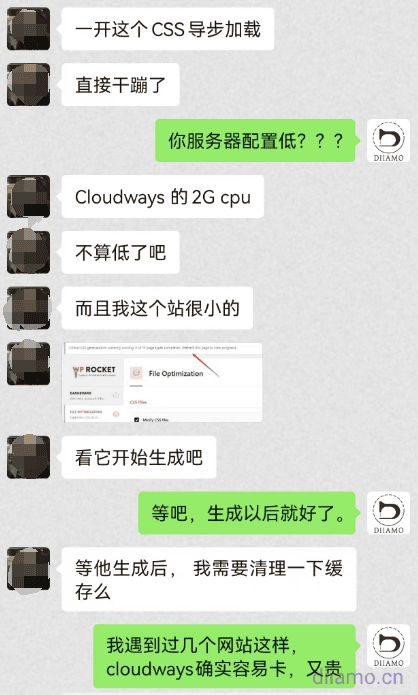
The preloading and resource optimization features of Little Rocket are a bit “aggressive” and can consume a significant amount of resources. If your server has low specifications, you may experience a prolonged period of lag after clearing the cache or updating settings. This issue is commonly encountered on Cloudways servers with lower specifications.
WP Rocket doesn't have enough features:
Little Rocket does not have object caching, dynamic caching bypass and other features, is not suitable for Woocommerce e-commerce sites and shopping sites with membership features (such as this site).
Summary:WP Rocket is primarily suitable for simple blog sites, corporate websites, and independent e-commerce sites....It's especially suitable for beginners. However, it's not recommended for e-commerce websites with membership-based shopping features.
FlyingPress
FlyingPressIt's only become popular in the last few years, it's a new caching plugin that came later, click to learn about itThe Story of Creating FlyingPress. A few years ago I saw this plugin introduced on the overseas speed guru TOM blog, and that's when I started to learn about it, and over the years more and more domestic bloggers have recommended it.
WordPressplug-in library (computing)There are a few other plugins in the "Flying" series, all from the same company as FlyingPress. They’re all very powerful and produce great results—you might want to give them a try. FlyingPress includes the features of these plugins.

FlyingPress is ahead of the curve in terms of features and technology, and is easy to use, with the aim of really solving problems, each feature works quite well and is simple to set up. It is much better thanWp RocketExcellent—it works even better. If you're not using LiteSpeed hosting, diiamo recommends using this caching plugin for even better results.
It offers many cutting-edge features that deliver excellent results—features not yet available in other caching plugins. It leans toward automation—for example, with features like smart link auto-preloading—which saves you the time and effort of figuring out how to configure things manually. However, since the settings cannot be adjusted, it may not be suitable for users who prefer to customize their settings manually.
If you use the FlyingPress caching plugin, you can also purchase theirFlyingCDNservice for $10 a month with the Cloudflare Enterprise package (Edge Location Caching, Argo Intelligent Routing, Polish Image Optimization). This CDN is the same as the high-end CloudWays and Rocket hosting CDNs, and the price is a great deal!

FlyingPress vs WP Rocket, which one is better?
Some users have asked Xiao Di which is better: FlyingPress (FP) or WP Rocket (Little Rocket). diiamo believes there’s no “best” option—only the one that’s right for you. In terms of performance, FlyingPress is definitely better; for the same features, FP delivers better results.
FP has a couple useful features that smaller rockets don't have:
- Merge Google Fonts Local Hosting, Backup Fonts, Remove Google Fonts feature;
- Automatically preloading the first screen image is important and works well;
- Automatic local hosting of Gravatar user avatar images, important and effective;
- Being able to buy Cloudflare Enterprise CDN for $10/month is superb and effective;
- Remove WordPress bloat, e.g. remove Woocommerce shopping cart code, disable XML-RPC, jQuery Migrate, Gutenberg CSS, etc;
- Locally hosting external (third party) JS, CSS files is important and practical ;
In terms of compatibility, stability, and ease of problem solving, Diiamo feels that Wp Rocket is more appropriate:
- Little Rocket is famous for its stability, its delayed loading JS has a quick troubleshooting function, and the official website has a very detailed tutorial on how to deal with problems. FP official tutorials are pathetic, about the same as none, problems have to rely on their own fumble;
- Little Rocket supports bundling Cloudflare, entering developer mode with one click, and cleaning CF cache automatically;
- Little Rocket offers a lot of code that allows you to fine-tune various aspects of its functionality. For example, you can adjust the number of preloaded caches processed per batch and the interval for removing unused resources to prevent the server from freezing. FP, on the other hand, does not support this, and its founder has stated that managing server lag is the responsibility of the server provider;
- Smaller rockets are cleaner, easier to use, and there are detailed tutorials available online, much to the liking of some users;
- It has a more aggressive page caching, preloading feature. It can cache pages faster and better, but it will increase the pressure on the server;
Note: The FlyingPress plugin does not support linking to the free version of Cloudflare CDN, so it cannot automatically clear the CF cache. You will need to install the free version separately.Cloudflare plugin, and the two can be used together. Xiao Di has already provided feedback to the FP team, hoping that future versions will support linking to Cloudflare Free, but I don't think they'll support it. The new version of V5+ now supports linksThe free version of the Cloudflare CDN.
Tip: FlyingPress can't disable caching can't be used with the LiteSpeed Cache caching plugin to take full advantage of LiteSpeed hosting. It is not recommended to use FlyingPress with LiteSpeed hosting.
Tip: Xiaodi feel FlyingPress a little "ecological closed" meaning, not compatible with some plug-ins and features, and even can not adjust the settings.
W3 Total Cache
W3 Total Cache(Also known as W3TC) is a long-standing plugin that has been well-known for many years. It is feature-rich, powerful, and offers fine-grained control. Incredibly, the free version of W3TC actually has more features and performs better than the paid version of WP Rocket!
W3TC is very full-featured , there are object caching , database caching , page dynamic caching ( bypassing dynamic caching ) , image compression and delayed loading , CSS/JS delayed loading and compression , according to different Cookies cache different content , security headers , etc., a plug-in top 3 .
Special Note: W3TC’s snippet caching feature provides cached HTML (page caching) to logged-in users, bypassing (not caching) dynamic data. It’s very fast, displays content normally, and greatly improves the speed of e-commerce and membership sites. Currently, only the LiteSpeed Cache and Super Cache plugins offer this feature.
However, this fragment caching feature has many usage restrictions and is quite a hassle to enable and configure. Beginners should steer clear of it; experienced users should use it sparingly; and experts can give it a try. W3TC offers very detailed functionality, allowing for precise control over every aspect—a real treat for those who love manual control! This site uses the W3TC caching plugin for optimization, and the results are clear to see.
The downside of W3TC is that it has a steep learning curve, and if not configured properly, its performance suffers significantly; that’s why many people prefer to use WP Rocket. In fact, when configured correctly, it outperforms WP Rocket and can achieve results that WP Rocket cannot, such as caching pages while bypassing dynamic content on specific pages.
If your site is a shopping site, or has a membership system, or the site has more dynamic data, it is recommended to use W3TC plugin.
LiteSpeed Cache
LiteSpeed hosting can only achieve system-level caching—and thus maximize its speed and load-handling capabilities—when using the LiteSpeed Cache (LSC) caching plugin. While Apache and Nginx hosting can also use the LSC caching plugin, the results are generally mediocre and not as effective as using plugins such as WP Rocket or FlyingPress.
The reason I’m mentioning this caching plugin is that Xiao Di has noticed some beginners using other caching plugins on LiteSpeed hosting, while using LSC on non-LiteSpeed hosting. I hope everyone avoids making this basic mistake.
LSC cache plugin is awesome, it is very powerful and complete, design ideas can be said to dump other plug-ins a few streets. Especially itsESI functionVery cow (OpenLiteSpeed does not support ESI functionality), you can achieve page caching while providing dynamic data, for logged in user access to accelerate, very suitable for e-commerce sites, membership sites.
LSC isn't perfect in every way; its configuration is a bit complex and prone to issues, and one wrong move could break your website—especially the ESI feature. Its CSS/JS optimization and image lazy-loading features actually aren't as effective or as finely tunable asPerfmattersPlug-in.
Super Page Cache Pro
Super Page Cache ProIt's a hidden gem of a niche caching plugin—lightweight, easy to use, feature-rich, and highly effective—just like the famousOptimoleThe plugin is also from Themeisle. Their technical team is highly skilled, and their customer support is excellent.
This plugin was initially available only as a free version, offering only caching functionality and designed specifically to integrate with the CloudFlare CDN (CF) to maximize its effectiveness. Later, a Pro version was released, adding features such as CSS/JS optimization, database cleanup, image lazy loading, and the ability to disable unnecessary CSS/JS files. It is very comprehensive and powerful.
As is well known, the Cloudflare CDN requires specific configuration to be most effective, but few people know how to set it up. This plugin automatically optimizes Cloudflare CDN settings to maximize the CDN's effectiveness.
If you’re building static websites—such as B2B e-commerce sites or blogs—and using the CloudFlare CDN, we recommend this plugin; its performance is on par with WP Rocket. It automatically creates CF Cache Rules to prevent sensitive pages from being cached and to cache HTML. It can also automatically create conversion rules,By ignoring common marketing and tracking parameters in URLs, these pages are cached, significantly improving loading speed.

NitroPack (Not Recommended)
NitroPackThe caching plugin is favored by Yan Sir and some bloggers, saying that it is close to fully automated optimization and can optimize the Google speed score to a high level. We know that NitroPack is easy to cause site anomalies, high speed score but the actual loading speed is not good, do not recommend using.
NitroPack is very controversial, many foreign users say it belongs to the black hat SEO, after using it, the speed of the website will be decreased or the layout of the website will be damaged. If you are interested, please go to Google and search for “NitroPack plugin Black Hat SEO”.
Who NitroPack is best suited for: anyone who uses an inferior server, has only a few bloated sites (instead of many), knows nothing about speed optimization, is overly concerned about page scores, and doesn't mind paying high fees.
A lifetime VIP member of our website who uses member privileges to enjoy our free one-on-one manual Q&A service had his website with NitroPack displayed differently on the homepage tablet and cell phone than in the Elementor editor. He bought the original version of Elementor and asked the customer service to deal with it through ticket.
But Elementor's customer service had even worse results after they messed with it, laughed me out of the room. After he uninstalled NitroPack and used Wp Rocket, the problem was solved automatically, and he was sure that it was NitroPack's influence. We don't recommend this kind of auto-optimization tool, it's not smart enough to solve the problem.
Much like Mandarin, manual hand tweaking/optimization is the dickens, haha.




The following is a quote from a well-known foreign blogger's TOM article and a comment response.


A friend of mine was trying to use Nitro to optimize his website's speed but couldn't figure it out, so he asked me for help.

Google test shows good score and speed, but the actual visit test reveals that the page loads slowly, images and content show up very late, and the top menu bar keeps going in circles  .
When you scroll down the page, some elements haven’t loaded yet (red box)↓ and are still loading. Nitro simply optimizes the score to look good; the actual loading speed hasn’t improved much and may even be slower. Since the elements don’t load in a timely manner, the actual speed and user experience aren’t very good.

Seraphinite Accelerator (Not Recommended)
AcceleratorCaching plugins have gained popularity over the years. Some website builders mention them, and people often ask Xiao D if they're any good. Xiao Di has used this plugin—it performs adequately but falls short of Wp Rocket and W3TC.
The free version has a monthly page view limit of 5,000. Once this limit is exceeded, the product will only cache pages without performing optimization. A banner ad appears at the bottom of the website. The premium version offers fewer features.
Seraphinite employs a radical strategy that skips right over WordPress' core checksum and hook execution processes to boost PageSpeed scores by forcing statics with deep resource optimization.
Although it is similar to other caching plugins that generate cache files in the wp-content directory, Seraphinite completely bypasses the data querying and processing part of WordPress and caches the final page directly.
While this approach delivers a more significant speed boost, first-time visitors trigger a cache refresh when dynamic content is updated, leading to performance dips and slowdowns, and is prone to compatibility conflicts with themes or plugins.
Other Caching Plugins
Wp Super Cache、Wp Fastest CacheThese 2 caching plugins are also well known, the former is still free and made by the official WordPress team. These 2 plugins are more simple and easy to use, but they don't have many features and are not as effective as theFlyingPress and Wp Rocket.
BreezesThis is a caching plugin developed by the Cloudways team. It’s simple and easy to use, but it’s never really taken off. In terms of features and performance, it doesn’t measure up to plugins like FlyingPress.
You can buy it here at a very low price.The GPL version of the FlyingPress cache plugin, no limit on the number of websites, valid for life.So there's no need to consider WP Super Cache, WP Fastest Cache, Breezes.
Nginx fastcgi_cache Caching
The highest level of swordsmanship is when “no sword is better than a sword,” and “everything can be a sword.” The highest level of caching is “no cache”—that is, system-level caching. To achieve top-tier website performance and speed, we recommend using the fastcgi_cache (Nginx caching). Technically savvy webmasters in China generally use FastCGI_cache for their own websites.
on top ofSystem-Level Caching vs. Software-Level CachingThe chapter mentions FastCGI caching (system-level caching) There areA lot of questions, , ,This is not recommended for beginners, but any issues can be resolved; webmasters with some technical background can give it a try.With AI assistance, enabling and configuring FastCGI is much easier now.
Once Xiao Di is done, I'll switch this site to fastcgi_cache caching as well. I'll post an update on the method in "How to Enable the fastcgi_cache in Nginx on the Baota Control Panel》Article.
The `fastcgi_cache` cannot cache dynamic content, but you can configure it to exclude certain pages from caching and not serve cached content to logged-in users, thereby preventing dynamic content from being cached.
Some shopping websites have a great deal of dynamic content, making it difficult to bypass dynamic caching—or, if bypassed, resulting in significantly poorer performance. For example, on this site (https://www.diiamo.cn), the header displays user avatars, and the plugin purchase page includes a purchase function; certain content only appears after a purchase is made, so direct caching would cause issues.
In this situation, you need to start by structuring the page and using technologies like Ajax to load dynamic content. This way, you can use `fastcgi_cache` to cache the entire HTML page without encountering errors.
Some content is built using specific plugins that cannot be converted to Ajax. In such cases, you can replace them with other plugins that support Ajax. Alternatively, you can use AI to rewrite the plugin to enable Ajax loading; however, once rewritten, the plugin cannot be updated, so you’ll need to maintain it yourself.
Why is the site still a bit slow after using a caching plugin?
Website speed is affected by numerous factors, such as the way the page is built (amount of CSS/JS on the front-end), image size, page size, font size, video factor, server factor, CDN usage, resource loading order, database query speed, resource loading, and so on.
Caching plugins primarily implement page (HTML) caching, reduce PHP execution and data queries, and delay image loading. However, there are many other factors that affect site speed which caching plugins cannot optimize; these require the installation of other plugins or additional optimizations.
Pre-caching is also an important reason for speed, pages with pre-caching load significantly faster and pages without pre-caching definitely load slower. To check if the main pages of your website are successfully pre-cached.
Different methods of using or configuring cache plugins can also lead to varying results—just as having a brush and a canvas doesn’t guarantee you’ll be able to create a great painting. Speed optimization is a skill and a body of knowledge that requires accumulation, practice, and constant refinement.
It is recommended to check out ourUltimate WordPress Speed Optimization Tutorialas well as theExcellent foreign trade hosting recommendations》, to comprehensively and thoroughly optimize your website. Or purchase our website speed optimization service; for details, please contact us.WeChat customer service.












7 thoughts on “热门WordPress缓存插件对比推荐,合适才最好,多年经验纯干货分享”
My blog vps server is openLiteSpeed +LiteSpeed Cache, very nice.
It's pretty good and free. Which panel did you install to implement openLiteSpeed?
The Pagoda Panel App Store can be downloaded and installed.
Is it the latest version or the old 1.7.17 version? Pagoda doesn't invest enough in non-mainstream stuff, and compatibility is so bad I'm afraid to use it.
The pagoda panel is really not up to date, it's still version 1.7. I have upgraded to the latest version 1.8. on the ssh side.
The latest version is 1.9. We recommend using the free advanced optimization panel xCloud. https://www.diiamo.cn/server-panel/I support Openlitespeed, it's free for 10 sites, and it's definitely better than Pagoda in terms of Openlitespeed.
Pagoda official forum, the official people said Openlitespeed user number is too small, not maintain. There are also a lot of people post feedback Openlitespeed a bunch of problems. It is recommended that you do not use Openlitespeed in the Pagoda panel in the future.